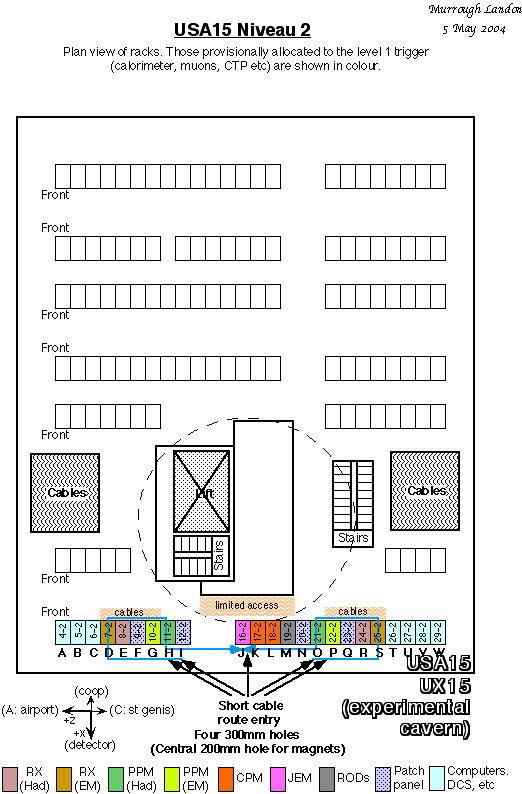
The only updates relate to the rack numbers following the latest rack layout and consequent changes to use of holes through the shielding wall.
>From LAr calorimeters
----------------------

I believe these cables are already completely entered into your cable
database.

Destinations of these cables are to the racks containing the receiver
stations. The layout isnt fixed, but probably to all of 7-2, 8-2,
23-2 and 24-2 on level 2 of USA15. (Subject to us changing our minds
about the rack layout).

Routing depends on the receiver/preprocessor layout, but via one
(or possibly both) of the holes on each side (C,A) through the
shielding wall.


>From Tile calorimeters
-----------------------

We have given Mark Hatch information about these cables in the past
but they arent in your database - presumably because they have not
yet been completely specified. There are 256 cables in total, 64
from each side of both barrel and extended barrel. 128 (from the
barrel) require 10 twisted pairs, 128 (from the extended barrel)
require 7 pairs. One possibility though is just to reuse the same
cables as for the LAr signal cables which have 16 pairs.

In any case, the technical specifications will be identical
as far as possible. And the lengths will be similar.

Destinations of these cables are to the racks containing the receiver
stations for the TileCal. The layout isnt fixed, but possibly to both
of 7-2 and 24-2 on level 2 of USA15. (Subject to us changing our minds
about the rack layout).

Again, routing depends on the receiver/preprocessor layout, but via
one (or possibly both) of the holes on each side (C,A) through the
shielding wall.


>From receivers to preprocessor
-------------------------------

Note that these cables pass in front of the crates! Paul Hanke
imagines the routing as going above each crate with some cables
having to pass up and down at the rack edges too.

The cables are the same type as the LAr signal cables (16 pairs)
and there will be roughly 500 of them. Most go directly from one
module to another, others need to be reorganised in patch panels.
Its basically 64 cables in and out of each crate (4 per module).


>From preprocessor to cluster & jet/energy processors
-----------------------------------------------------

These cables go from the back of the preprocessor crates under the
floor to the cluster and jet/energy processor crates, preferably
using the top underfloor cable tray to minimise the total length.

I dont know the exact spec, but they are mainly 4 pair LVDS cables
with a small subset (5%) being 2 pair LVDS cables. There will be
a large number of these little thin cables (certainly less than
10 by 2 mm) and they have a complex mapping from crate to crate.

I cant give exact paths as the layout of the preprocessor crates is
not yet decided depending on whether we optimise the receiver to
preprocessor cabling (likely) or the preprocessor to cluster/jet
crates (unlikely). But in the (unlikely) simplest arrangement for
these cables each preprocessor crate sends (in most cases):

    8*14 = 112 cables to one cluster crate
    1*14 =  14 cables to a second cluster crate
    1*14 =  14 cables to a third cluster crate
    4*16 =  64 cables to one jet/energy crate
    2*16 =  32 cables to the other jet/energy crate

Thats a total of 236 cables from each of the eight preprocessor crates,
352 cables into each of the four cluster crates and 384 into each of
the two jet/energy crates. A bit under 1900 cables in total.


>Special routes for small numbers of cables
-------------------------------------------

We have mentioned to Mark Hatch before that we will need to send
a few (eg twelve) cables on a short route through the floor to the
CTP on USA15 level 1 - ie via a small hole in the floor/ceiling.

If latency is tight, we will also want to send about four cables
directly from one cluster processor rack to the next one without
going down under the floor. Ie make a very small hole in the side
of two adjoining racks.